Review: Teacher Mode Off Striped Last Day Design
As a designer who spends more time staring at stitch simulations than I care to admit, I approach every new machine embroidery design with a healthy dose of skepticism. We have all been there: you download a cute graphic, load it onto your machine, and watch in horror as the thread nests into a bird’s nest because the digitizing was an afterthought. That is why I took a close, practical look at the Teacher Mode off Svg, Striped Last Day file. This is not just about whether it looks good on a screen; it is about how it performs when the needle hits the fabric.
First Impressions and Visual Personality
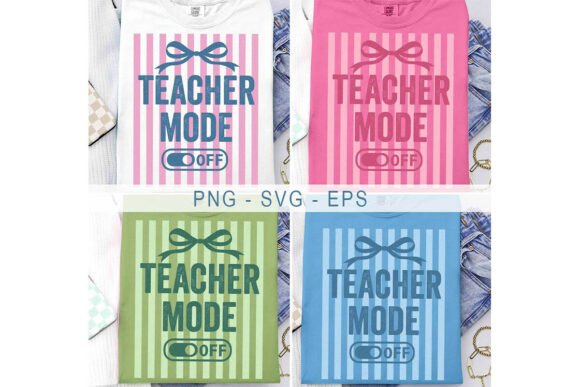
The first thing that strikes me about this design is its timing and tone. "Teacher Mode Off" is a phrase that resonates deeply with educators, particularly at the end of a grueling school year. The addition of "Striped Last Day" suggests a playful, relaxed aesthetic, likely incorporating horizontal lines or a casual, breezy layout. Visually, it feels like a breath of fresh air. It does not try to be overly ornate or dense. Instead, it leans into simplicity, which is often where modern T-Shirt Designs shine.
The mood is celebratory but understated. It captures that specific feeling of closing the classroom door for the final time in June. For an embroidery project, this simplicity is a double-edged sword. Simple designs require precise digitizing because there are no complex fill stitches to hide behind. Every line and curve must be clean. From what I can see in the preview, the lines appear crisp, suggesting that the underlying vector paths are well-constructed. This is crucial for anyone looking to create high-quality Graphics for commercial use.
Real-World Application: The End-of-Year Gift
Let us move from theory to practice. Imagine you are running a small shop or an Etsy store, and it is May. Your inbox is filling up with requests for end-of-year teacher gifts. A generic mug is fine, but a personalized item holds more value. I envision using this design on a high-quality canvas tote bag or a lightweight French terry sweatshirt.
For a tote bag, the design’s linear elements would translate beautifully. Canvas has a tight weave, providing a stable surface for stitching. If the "striped" element involves parallel lines, they would lay flat without puckering, provided the stabilizer is correct. On a sweatshirt, the design sits comfortably on the chest or slightly off-center for a modern look. The text "Teacher Mode Off" becomes a badge of honor for the recipient. It is not just clothing; it is a personalized gift that acknowledges their hard work. This emotional connection drives sales for craft business owners far more than generic clipart ever could.
Fabric and Hoop Considerations
When working with this type of design, fabric choice is paramount. Because the design likely features text and linear stripes, you must avoid fabrics that are too textured or fuzzy. A looped terry cloth might swallow the finer details of the lettering. Instead, opt for smooth cotton blends, polyester performance fabrics, or structured canvas.
Hoop size is another critical factor. While the design may fit in a standard 4x4 inch hoop, giving it more breathing room in a 5x7 inch hoop allows for better stabilization and prevents the fabric from pulling away from the edges during stitching. If you are placing this on a curved surface, like a cap, you need to ensure the design is not too wide. Curved surfaces distort horizontal lines. If the "striped" aspect relies on perfect horizontality, a flat item like a pillow cover or apron is a safer bet than a dad hat.
Technical Performance and Stitch Quality
Digitizing for embroidery is different than designing for print. In print, you can have infinitely thin lines. In embroidery, every line must have substance. When evaluating this digital embroidery file, I look for appropriate stitch types. Text should ideally use a satin stitch for clarity and sheen, while any larger striped areas might use a fill stitch or a patterned run stitch to keep the density manageable.
If the stripes are too dense, you risk creating a stiff patch that pulls on the garment. This is especially important for baby embroidery or items that need to remain soft and flexible. I recommend checking the stitch density settings if your software allows it. For a design like this, lower density is often better. It reduces thread consumption, speeds up production time, and results in a softer hand feel. Always test the design on scrap fabric first. Check for thread breaks, especially at the start and end of the stripes. Poorly connected jumps can lead to messy backsides, which matters if you are selling high-end custom apparel.
Color Contrast and Thread Selection
The visual impact of this design relies heavily on contrast. Since it is likely text-based with graphic elements, the thread color must stand out against the fabric. White thread on a light gray shirt will vanish. For a "Last Day of School" vibe, consider vibrant colors like sunshine yellow, sky blue, or classic navy. However, remember that multi-color designs increase production time due to thread changes. If the design is single-color, it is faster to produce, making it ideal for bulk orders for school staff.
Test your design in black and white mockups before committing to thread. If the design loses its definition in grayscale, it may lack sufficient contrast for real-life viewing. This step saves you from wasting expensive thread on a project that looks muddy from a distance.
Commercial Viability for Etsy Sellers
For Etsy sellers and small shop product creators, versatility is key. This design fits neatly into several niches: education, seasonal holidays, and humor. It is not limited to teachers; it could appeal to professors, tutors, or even parents homeschooling their kids. By positioning it as a versatile embroidered patch or a direct-to-garment style embroidery, you expand your customer base.
However, you must verify the licensing. The product description mentions receiving SVG, PNG, DXF, and EPS files. These are primarily cut files for vinyl or sublimation, not necessarily native embroidery formats like PES or DST. This is a crucial distinction. If you are an embroiderer, you will need to digitize these vectors yourself or convert them using specialized software. Ensure you have the rights to create derivative works for commercial sale. Never assume a SVG purchase includes commercial embroidery rights. Always read the license terms carefully to protect your craft business from legal issues.
Final Verdict and Designer Notes
The Teacher Mode off Svg, Striped Last Day design offers a strong foundation for end-of-year projects. Its strength lies in its relatability and clean aesthetic. However, its success depends entirely on execution. Do not skip the test stitch. Use a quality cut-away stabilizer for stretchy fabrics like t-shirts to prevent distortion. For woven fabrics like tote bags, a tear-away stabilizer may suffice.
Pay attention to the small details. Are the corners of the letters sharp? Do the stripes align evenly? These micro-details separate amateur hobbyist work from professional commercial embroidery. If you take the time to refine the stitch path and choose the right materials, this design can become a staple in your summer collection. It is a reminder that even simple graphics, when executed with precision, can create meaningful, high-value products for your customers.